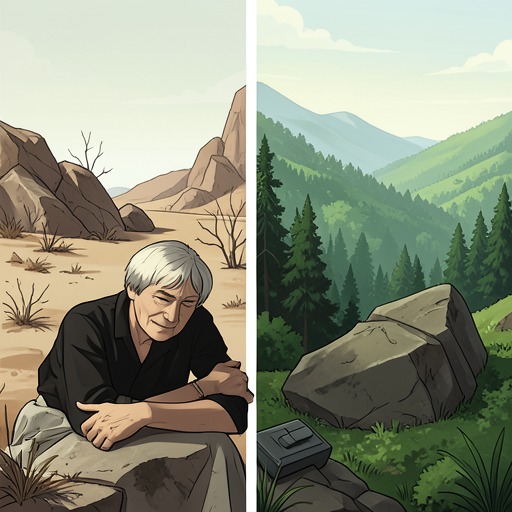
Terra’s survival-control regime
The DispossessedTerra’s survival-control regime is the total centralization imposed on a ruined planet to keep its remaining population alive. Keng presents it not as an ideal social order but as an emergency inheritance: humanity failed to restrain its appetites and violence, destroyed its world, and then regimented life around the bare objective of species survival. Her account makes Terra a dark counterpart to both Urras’s abundance and Anarres’s chosen austerity, showing how ecological ruin can turn collective survival into comprehensive control.
Ruin and Survival
Keng describes Terra as habitable but profoundly damaged. Humans multiplied, consumed resources, and fought until they had destroyed the world before destroying themselves; the forests were gone, the air and sky grey, and the climate perpetually hot. The population had fallen from nine billion to nearly half a billion. Old cities remained, their bones and bricks returning to dust while small pieces of plastic endured, an image of material persistence without ecological recovery.
The Terrans survived in the ruins through what Keng calls total centralization. The regime controlled every acre of land, every scrap of metal, and every ounce of fuel. It imposed total rationing, birth control, euthanasia, and universal conscription into the labor force, directing each life toward racial survival. These measures belong to a single governing logic: under conditions of radical scarcity, resources and human lives are administered as parts of a system whose overriding purpose is the continuation of the population.
A Planetary Counterpoint
The regime’s history is set against the contrasting environmental histories of Anarres and Urras. Anarres’s Dust was once a vast holum forest; millennia of drought killed the trees and dried the soil into fine grey dust. The Anarresti sought to restore the land through replanting, treating damaged ecology as something to be repaired through collective work. Terra, by contrast, is described as a world its inhabitants themselves made into a desert through uncontrolled consumption and conflict. Keng’s contrast distinguishes living with a harsh environment from producing ecological devastation.
Urras appears to the Terran visitor as a living world and a vital society, even a paradise viewed from outside. Yet the Terrans can only admire it and perhaps envy it slightly: their own history has left them capable of looking at such abundance without imagining that they can recover an equivalent future. Keng tells Shevek that Anarres means nothing to Terra because the Terrans forfeited their chance for such a society centuries before Anarres came into being. The regime thus represents not merely a different political arrangement but the narrowed horizon left by irreversible historical damage.
Aid, Isolation, and Political Meaning
Terran survival did not end with centralization. Keng says that the Hainish came to Terra, brought help, and built ships that enabled Terrans to leave their damaged world. The Hainish treat them gently, as the strong treat the sick; Keng associates their generosity with a deep, largely incomprehensible sense of guilt and an immense past. Interplanetary contact has given Terra a measure of hope, but Keng says that hope has been outlived. The Terrans can engage with other human societies as equals, yet their relation to Urras remains one of looking in from outside.
The regime sharpens the novel’s comparison between scarcity and political choice. Anarres also faces ecological limits, and its drought exposes the dependence of food on water, plants, transport, and labor. When a train carrying 450 travelers is stranded in a town of 160 people with no food to spare, the community gives them nothing rather than risk its own survival; elsewhere, a worklister describes ration lists that assigned already sick people half rations from which they could not recover. These episodes do not make Anarres equivalent to Terra’s total centralization. They show instead how scarcity can press even a society committed to sharing toward decisions that administer life through work, food, and survival. Terra’s history gives that pressure its most extreme form: a system that saves a population by subordinating each life to collective continuance.
The novel also places centralization beside the use of coercive authority elsewhere. During the war over Benbili, A-Io’s restrictions include classified research, delays in publication, and limits on Shevek’s travel away from the university campus without the Chancellor’s clearance. In the Nio Esseia uprising, police helicopters drown out a speaker and fire into a crowd in Capitol Square; the frightened crowd surges into the Directorate, where the word DOWN is smeared in blood across a wall. These are not features of Terra’s regime, but they make visible the broader political danger of treating emergency, security, or survival as grounds for overriding ordinary freedom. Against those forms of control, Keng’s history presents Terra as a society whose emergency never ended: survival became the organizing principle of every life.